

Teejan Bai: The Historic Struggle for the Right to Sing and the Democratization of Indian Folk Culture
Ram Ahlad Choudhary
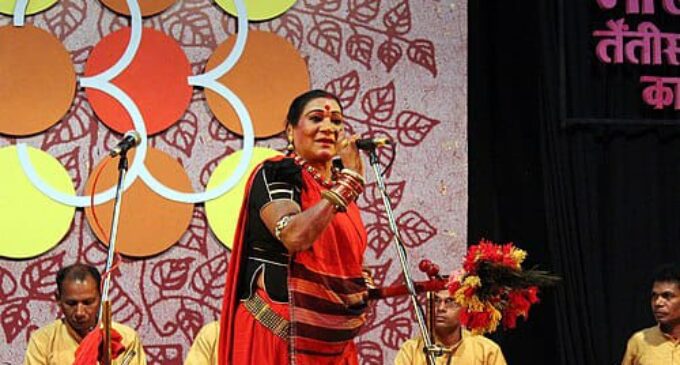
The demise of Teejan Bai, the iconic folk artist of Chhattisgarh, signifies far more than the passing of an exceptional performer. It marks the conclusion of a transformative chapter in the cultural history of modern India, one in which folk art emerged as a powerful instrument of social resistance, women’s emancipation, and cultural democratization. To interpret her life merely as the story of an extraordinarily successful folk singer would be to overlook the deeper historical and socio-cultural significance of her contribution. Rather, Teejan Bai’s life offers a compelling lens through which to examine questions of gendered access to cultural production, caste-based exclusion, the politics of folk traditions, and the democratization of artistic practice in contemporary India.
Popular narratives frequently celebrate Teejan Bai as a “naturally gifted” artist or as someone endowed with extraordinary talent by divine providence. Such interpretations, however, obscure the structural realities that shaped her artistic journey. The romanticization of innate genius often renders invisible the social, cultural, and institutional barriers that artists from marginalized communities must confront. Teejan Bai’s life fundamentally challenges this mythology. Her greatness did not arise solely from the exceptional quality of her voice or performance; it emerged from her courageous determination to contest a social order that denied women the very right to perform in public.
Folk Culture and the Paradox of Patriarchal Tradition
Indian folk culture is frequently described as democratic, collective, and organically connected to the everyday lives of ordinary people. While this characterization contains an element of truth, it remains incomplete. Folk societies, like all social formations, are deeply embedded within structures of power shaped by caste, gender, class, and religious hierarchies.
The tradition of Pandavani, the celebrated oral performance of the Mahabharata, exemplifies this contradiction. For generations, Pandavani was regarded as an exclusively male performative domain. Women were discouraged—and often prohibited—from appearing on public stages. This represented a profound irony: while the tradition narrated the lives and sufferings of women such as Draupadi, Kunti, and Gandhari, actual women were denied the authority to narrate these stories themselves.
It was within this context that the young Teejan Bai, born in the village of Ganiyari, initiated one of the most significant cultural interventions in modern Indian folk history. Her resistance did not begin through organized political mobilization or ideological proclamation. Instead, it began with a simple yet revolutionary act: she exercised her right to sing.
Singing as a Cultural Right
Although the Constitution of India guarantees freedom of expression as a fundamental right, the practical realization of this freedom has historically remained uneven. Across numerous communities, women’s participation in public speech, literature, theatre, music, and performance has been constrained by deeply entrenched patriarchal norms.
Viewed from this perspective, Teejan Bai’s struggle transcended the domain of artistic practice. It represented a struggle for cultural citizenship. She challenged the assumption that folk traditions belonged exclusively to men and asserted that women possessed an equal claim over the cultural inheritance of the community.
Her life invites a broader philosophical question: should artistic expression itself be understood as a fundamental cultural right? If singing constitutes one of the most powerful forms of human expression, then denying women the opportunity to perform publicly amounts to denying them a crucial dimension of democratic participation. Teejan Bai’s career thus expands the meaning of democracy beyond political institutions to encompass cultural freedom and artistic agency.
Intersections of Caste and Gender
Teejan Bai’s struggle cannot be understood solely through the framework of gender. She belonged to the Pardhi community, a socially marginalized and economically disadvantaged group whose members have historically faced discrimination and exclusion.
The intersection of caste and gender placed her at the receiving end of multiple forms of oppression. As a young woman from a marginalized community, she confronted patriarchal authority, caste prejudice, economic insecurity, and social ostracism simultaneously.
Her excommunication by members of her own community was therefore not merely an individual punishment. It represented the collective response of a patriarchal social order determined to preserve existing structures of authority by disciplining women who transgressed prescribed cultural boundaries.
From Child Marriage to Artistic Self-Determination
Married at the age of twelve and leaving her marital home only a year later, Teejan Bai made a decision that fundamentally challenged prevailing social norms. In the context of rural India during the mid-twentieth century, such an act represented extraordinary courage.
Rather than accepting the conventional expectations associated with marriage and domesticity, she chose the uncertain path of artistic dedication. Through this decision she asserted the possibility that a woman’s life could be defined by intellectual, artistic, and professional aspirations rather than exclusively by familial obligations.
Her life thus became an enduring affirmation of women’s autonomy and creative selfhood.
Reinventing the Tradition of Pandavani
Among Teejan Bai’s greatest artistic achievements was her creative transformation of Pandavani itself. She expanded the traditional format by incorporating dramatic characterization, dialogue, gesture, physical movement, and theatrical performance, thereby converting an oral narrative tradition into a dynamic performative experience.
Under her interpretation, the Mahabharata ceased to function merely as a sacred text. Instead, it became a living social document capable of addressing contemporary human dilemmas. Through remarkable performative versatility, she embodied Bhima’s strength, Arjuna’s moral conflict, Krishna’s political wisdom, Karna’s anguish, and Draupadi’s humiliation with equal conviction.
Her performances demonstrated that folk traditions are neither static nor fossilized. They survive precisely because they continually reinterpret inherited narratives in response to changing historical realities.
A Democratic Interpretation of the Mahabharata
The Mahabharata presented by Teejan Bai differed significantly from elite or courtly interpretations of the epic. Her performances foregrounded the experiences of those positioned at the margins rather than the triumphs of kings and dynasties.
Characters such as Karna, Ekalavya, Draupadi, and Bhima acquired renewed significance through her interpretations, emphasizing exclusion, injustice, dignity, and collective strength. In this sense, her Pandavani articulated a distinctly democratic and people-centred reading of one of India’s foundational epics.
This capacity to reinterpret canonical narratives from the perspective of ordinary people constitutes one of the defining characteristics of living folk traditions.
Reimagining the Public Identity of Women Performers
Historically, women associated with music and theatre in India frequently encountered suspicion and social stigma. Their artistic accomplishments often remained overshadowed by moral judgments imposed upon public women performers.
Teejan Bai fundamentally altered this perception. She established that a woman performer could simultaneously embody artistic excellence, historical consciousness, intellectual authority, and cultural leadership.
Her unprecedented success inspired numerous young women to enter the field of Pandavani, thereby permanently transforming the gender composition of the tradition. The growing participation of women performers today stands as one of the most enduring outcomes of her lifelong struggle.
Negotiating Tradition and Modernity
Despite receiving national and international acclaim, Teejan Bai remained firmly rooted in the linguistic, musical, and performative traditions of rural Chhattisgarh.
Her career demonstrated that modernity need not imply the abandonment of indigenous cultural forms. Rather, genuine modernity lies in the creative reinterpretation and revitalization of tradition within changing historical contexts.
Habib Tanvir and the Nationalization of Folk Performance
A decisive moment in Teejan Bai’s artistic career came during the 1970s when the eminent playwright and theatre director Habib Tanvir recognized her extraordinary talent and introduced her to wider theatrical audiences.
Tanvir’s pioneering engagement with folk performance traditions helped integrate regional artistic practices into the mainstream of Indian theatre. Through this association, Teejan Bai emerged from a local performer to an internationally celebrated cultural ambassador, bringing Pandavani to audiences across the globe.
Beyond Awards: Measuring Cultural Achievement
Although Teejan Bai received numerous prestigious civilian honours and national awards, these recognitions alone cannot define the magnitude of her contribution.
Her most enduring achievement lies in the transformation of social consciousness. She fundamentally altered the cultural landscape by securing for future generations of women the legitimacy to perform Pandavani publicly without fear of exclusion or social condemnation.
This social transformation remains far more significant than any institutional recognition.
Contemporary Relevance
In contemporary India, where debates surrounding gender justice, cultural rights, and democratic participation continue to evolve, Teejan Bai’s legacy possesses renewed relevance.
Even today, many girls encounter restrictions on participating in music, theatre, dance, and other performing arts. Cultural practices continue to be regulated through patriarchal notions of honour and respectability.
Teejan Bai’s life reminds us that rights are rarely bestowed voluntarily; they are won through sustained resistance and collective struggle.
Implications for Cultural Policy
Current cultural policies in India often prioritize the preservation of folk traditions while paying comparatively limited attention to the social conditions of folk artists themselves.
The long-term vitality of India’s folk heritage requires more than festivals and ceremonial recognition. It demands sustained investment in artists’ livelihoods, social security, institutional support, educational infrastructure, and opportunities for younger generations.
Particular emphasis must be placed upon creating equitable, secure, and enabling conditions for women folk artists, whose participation remains indispensable to the democratization of India’s cultural sphere.
Conclusion
Teejan Bai occupies a unique position in the cultural history of modern India. She demonstrated that art is not merely a vehicle of aesthetic pleasure but also a transformative force capable of challenging entrenched systems of social inequality.
By asserting the right to sing, she transformed artistic practice into an assertion of dignity, equality, and cultural citizenship. Her legacy extends beyond the preservation of Pandavani; it resides in the enduring struggle against patriarchy, caste hierarchy, and cultural exclusion.
Her life affirms that folk traditions remain genuinely alive only when they continue to speak in the language of the people, defend their rights, and nurture their aspirations for justice and freedom.
Although Teejan Bai is no longer physically present, her voice will continue to resonate wherever women claim their rightful place upon the public stage without fear or inhibition. That enduring resonance constitutes her greatest memorial and her most profound contribution to the democratization of Indian folk culture.


